

1099 vs. W-2 Dental Staffing: What Practice Owners Risk by Misclassifying Workers
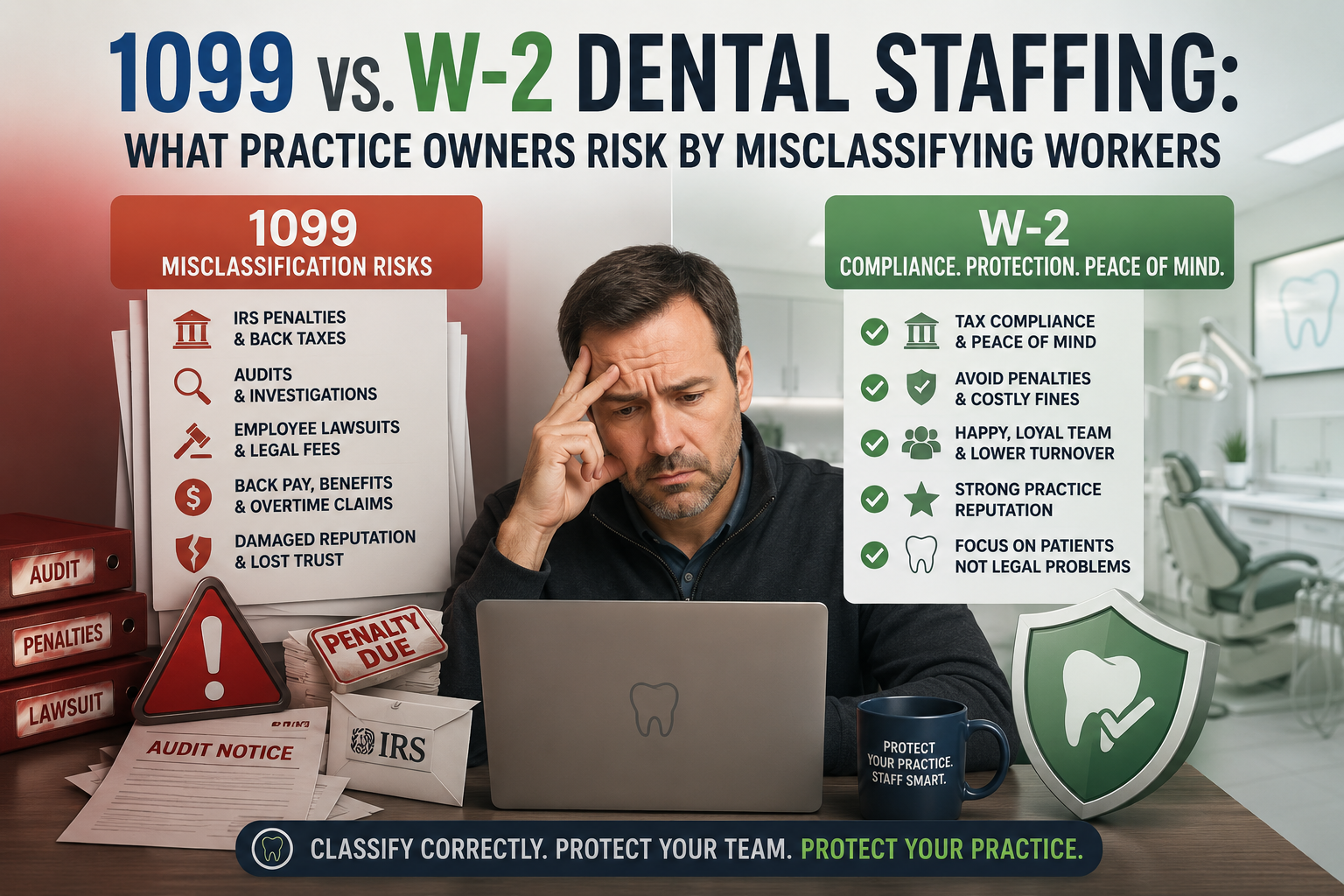
When your hygienist calls in sick an hour before opening, the fastest fix can feel like the best one: bring in a temp, pay them as a 1099 contractor, and move on. No payroll setup, no benefits, no paperwork. But that shortcut can expose your practice to serious legal, financial, and reputational risk — and most practice owners don’t find out until an audit letter arrives.
Have you thought about the additional steps that go into bringing on a temp yourself? Are you collecting the documents you need from them in order to pay them? How are you paying them — 1099 or W-2? If you’re paying them as a 1099, the cost doesn’t stop when you write a check at the end of the day. There’s much more to think about: the time it takes to onboard them, the time it takes to cut a check, and at the end of the year, paying your CPA or accountant to process a 1099.
Now let’s talk about paying them as a W-2. Yes, there’s cost, time, and risk associated with this too. You’ll need to onboard them, complete new hire reporting, and add them to your payroll system — whether internal or outsourced, this all costs you money. And then there’s employment claims. Did you know that if an employee works even one day at your practice, they may be eligible for employment benefits? It might not amount to much, but the time it takes to file a claim is still time — and time is money.
Don’t forget this: if you were paying that worker as a 1099 contractor, you’re carrying a real risk that could ultimately put you in the crosshairs of an IRS audit.
Many of our clients work with Dental Dynamic Staffing because they know we have their best interests at heart. With 20+ years as a W-2 employer, we have your back.
There are many types of staffing agencies out there. Some have offices that pay the dental professional directly; others pay the temp — but the big question is whether they’re paying them as a 1099 or as a true W-2. There’s a lot of smoke and mirrors in this industry. It’s important to ask the question and fact-check. We know offices just want their coverage need met, but here at Dental Dynamic Staffing, we want to keep you compliant.
If you’ve ever asked yourself, “Is my dental hygienist a 1099 or W-2 worker?” — you’re not alone. It’s one of the most common, and costly, points of confusion for practice owners who rely on a dental temp staffing agency to fill last-minute gaps. Understanding the difference between 1099 and W-2 dental staffing isn’t just an HR detail — it directly affects your practice’s tax exposure, insurance coverage, and legal liability.
The Core Difference: Control, Not Convenience
Understanding IRS worker classification rules starts with one principle: the IRS doesn’t classify workers based on what’s easiest for the employer. It looks at behavioral control, financial control, and the nature of the relationship. If your practice sets the hours, provides the equipment, trains the person on your protocols, and directs how the work gets done, that worker looks like an employee in the eyes of the law — regardless of what the paperwork says.
Most temporary dental staff — hygienists, assistants, EFDAs, front office support — meet this bar. They use your chairs, your sterilization equipment, and your scheduling system, and they follow your clinical protocols. That’s a W-2 relationship, even if they’re only in your office for a single shift. A true independent contractor dental hygienist relationship is actually quite rare in a clinical setting — most “1099 hygienists” are, legally speaking, misclassified employees.
What's Actually at Stake
- IRS and State Penalties. Misclassification isn’t a paperwork technicality — it’s a compliance failure with real financial consequences. 1099 misclassification penalties for small businesses can include back payroll taxes, the employer’s share of Social Security and Medicare, unemployment insurance contributions, and penalties and interest on all of it. Multiply that across every “1099 temp” used over the past few years, and the exposure adds up fast.
- No Workers’ Compensation Coverage for Temporary Dental Employees. If a 1099 worker is injured in your office — a needlestick, a slip near the sterilization area, an ergonomic injury — they typically aren’t covered by your workers’ comp policy the way a W-2 employee would be. That leaves your practice financially exposed to a direct claim, and potentially without the liability shield workers’ comp is designed to provide. Some 1099 workers carry Occupational Accident Insurance (OIA), which they pay into themselves — but it doesn’t come close to the protection offered by true workers’ compensation coverage.
- Malpractice Insurance Gaps for Temp Dental Staff. This is the risk practice owners underestimate most. Many independent contractors carry limited or no malpractice coverage of their own, and your practice’s policy may not extend to cover a 1099 worker’s clinical actions the same way it covers employees. If something goes wrong during a procedure, you could be left without the coverage you assumed was in place. We hope nothing ever happens — but it’s better to stay protected than take that chance.
- Dental Board Scrutiny. Some state dental boards look closely at supervision and employment arrangements, particularly for expanded-function roles like EFDAs and EDDAs. An improperly classified worker performing duties under an unclear supervisory relationship can create licensing complications for both the practice and the individual — on top of the tax exposure.
- Reputational and Operational Risk. Beyond fines, misclassification creates instability. Contractors who feel treated as disposable labor are less likely to return, less invested in patient outcomes, and more likely to walk mid-shift for a better offer. High turnover in temp coverage translates directly into inconsistent patient care and administrative churn for your team.
The W-2 Alternative: Compliance Without the Overhead
The good news: you don’t have to choose between compliance and flexibility. A W-2 dental staffing agency employs the temporary professional directly — handling payroll taxes, unemployment insurance, workers’ compensation, and malpractice coverage — while your practice simply requests and directs the work. This structure gives you:
- Employer-paid taxes and insurance, handled entirely by the staffing agency, not your practice
- Full workers’ compensation coverage for any on-site injury
- Malpractice insurance that actually applies to the person treating your patients
- Vetted, credentialed professionals with verified licenses and continuing education, checked before they ever walk into your office
- The same day-of flexibility you’d get from a 1099 arrangement, without inheriting the liability
In practice, this means you can fill a call-off, cover a leave of absence, or staff a busy season without creating a compliance exposure that could resurface years later in an audit. Dental Dynamic Staffing has more than 20 years of experience keeping our clients protected with true W-2 employment.
Please note: The salary figures above represent average compensation ranges. Actual earnings may vary depending on several factors, including geographic location, years of clinical experience, certifications, staffing model, and the practice category.
The Bottom Line
Convenience today can become liability tomorrow. Misclassifying dental staff as 1099 contractors might save a few administrative steps in the moment, but it shifts real financial, legal, and clinical risk onto your practice — risk that a properly structured W-2 staffing relationship is designed to eliminate.
If you’re currently relying on 1099 arrangements to fill staffing gaps — or aren’t sure how your temporary staff are being paid — it’s worth a closer look at how those roles are actually being managed day to day. The distinction between “contractor” and “employee” isn’t just a tax classification — it’s a question of who’s protected if something goes wrong.
Dental Dynamic Staffing entered the market more than 20 years ago, back when staffing agencies were few and far between and many firms had dental offices pay professionals directly. In 2005, a large DSO we were serving in Ohio reached out to us for help in Pennsylvania after facing employment claims — and after several of their offices were audited, the only issue on their P&L turned out to be a misclassified temporary staffing line. We’ve always been a true W-2 employer of record, and we pride ourselves on the customer service and peace of mind that comes with it.
Whether you run a single private practice or oversee dental practice compliance staffing across a multi-location DSO, partnering with a W-2 compliant staffing agency is one of the simplest ways to close this risk without adding administrative overhead. As a nationwide dental staffing agency in the USA, Dental Dynamic Staffing handles the vetting, payroll, and insurance so you can focus on patient care — not paperwork.
Frequently Asked Questions
What is the difference between 1099 and W-2 dental staffing?
A W-2 dental professional is a direct employee of the staffing agency or practice, with taxes, insurance, and benefits handled by the employer. A 1099 worker is an independent contractor who covers their own taxes and typically has no employer-provided insurance or benefits. Most temporary dental staff who follow a practice’s schedule, equipment, and clinical protocols legally qualify as W-2 employees, not contractors.
Does workers’ compensation cover 1099 dental contractors?
Generally, no. Independent contractors are typically not covered by a practice’s workers’ compensation policy, which leaves the practice financially exposed if a 1099 worker is injured on-site.
What are the penalties for misclassifying a dental employee as a 1099 contractor?
Practices found to have misclassified workers can be held liable for unpaid payroll taxes, the employer’s share of Social Security and Medicare contributions, unpaid unemployment insurance, and additional penalties and interest — potentially applied retroactively across every misclassified worker.
Does malpractice insurance cover 1099 dental staff?
Not always. Many independent contractors carry limited or no malpractice coverage of their own, and a practice’s malpractice policy may not automatically extend to a 1099 worker’s clinical actions, creating a coverage gap if an incident occurs.
How does W-2 dental staffing protect a practice from compliance risk?
A W-2 staffing agency employs the dental professional directly, handling payroll taxes, unemployment insurance, workers’ compensation, and malpractice coverage. This gives practices day-of staffing flexibility without taking on the legal and financial liability of a misclassified worker.
Related posts

Recent Posts

Dental Staffing Agency: How to Choose the Right One