

W-2 vs 1099 Employees: Legal Risks Dental Practice Must Know
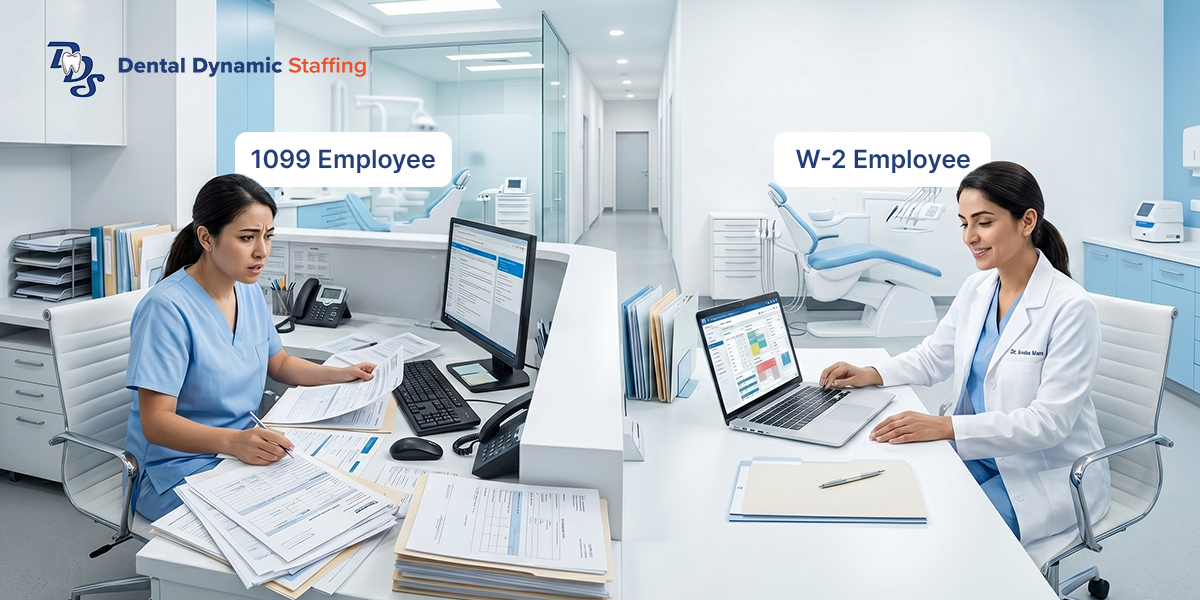
In the United States, worker classification is not just an administrative requirement for dental practices. It directly impacts tax compliance, legal exposure, and overall operational stability. As the regulatory scrutiny of the nation increases, dental practices must know the difference between hiring W-2 vs. 1099 employees and how they affect their operational activities. Missteps in this can lead to serious consequences, including audits, penalties, and back payments. It is one of the reasons why many dental offices in the USA prefer W-2 dental staffing and rely on trusted dental staffing agencies.
How the IRS Determines Worker Classification in Dental Practices
In the USA, the Internal Revenue Service (IRS) determines worker classification based on the relationship between a dental practice and its staff. The IRS evaluated worker classification based on three key factors: behavioral control, financial control, and the type of relationship.
- Behavioral control: It considers whether the practice has direct right and control over the employees, including their schedules, day-to-day responsibilities, and clinical procedures.
- Financial control: The IRS evaluates who controls the financial aspects of the job, such as payment structure, expense responsibility, and provision of tools or equipment.
- Type of relationship: It is determined based on factors like written agreements, duration of the working relationship, and whether benefits or long-term commitments are involved.
Major types of worker classification are employees, independent contractors, statutory employees, and statutory nonemployees. The employee classified dental professional receives a Form W-2 (Wage and Tax Statement). It is an official tax document issued by employers in the United States to report an employee’s annual wages and the taxes withheld from their pay check. While the practices issue independent contractors Form 1099-NEC (Nonemployee Compensation) – a tax document used to report payments made to independent contractors.
W-2 vs. 1099 - What These Classifications Actually Mean
Understanding the difference between W-2 employees and 1099 contractors is essential for dental practices and professionals alike, as each classification carries distinct responsibilities, tax implications, and legal protections.
What Is a 1099 Contractor in a Dental Practice?
A 1099 contractor in a dental practice is an independent professional who provides services on a contractual basis. Common 1099 employees in the dental sector include temporary staff or Locum Tenens who are assigned to a practice for short-term projects. Generally, these employees are not on the practice’s payroll and are responsible for managing their own taxes, insurance, and business expenses. They are not entitled to any benefits from the practice, such as paid time off, health insurance, or unemployment benefits.
Though hiring 1099 contractors offers flexibility to the practices, it also causes certain legal and financial risks for dental offices if they are treated like employees. It may lead to IRS audits, back taxes, and penalties related to 1099 classification risks. Additionally, it also gives limited control over the employees’ work, resulting in inconsistent patient care.
What Is a W-2 Employee in a Dental Practice?
W-2 dental staffing means the employee is hired directly by the practice. W-2 employees give dental practices greater control over schedules, workflows, and patient care standards, which helps maintain consistent service quality. For such employees, the practice is responsible for withholding income taxes and paying payroll taxes, and often providing employee benefits such as health insurance, paid time off, and retirement plans.
This classification also reduces the risk of IRS audits and misclassification penalties, ensuring compliance with US labor and tax regulations. On the other side, hiring W-2 employees increases operational costs to the practice due to payroll taxes, benefits, insurance, and compliance requirements.
Key Differences Between W-2 Employees and 1099 Contractors
| Factor | W-2 employees | 1099 contractors |
|---|---|---|
| Control over staff | Full control over schedules, clinical protocols, and patient care standards | Limited control over how the work is performed |
| Workforce stability | Reliable long-term team members | Short-term project-based employees |
| Long-term growth | Supports building a stable dental team | Suited for temporary gaps or specialised tasks |
| Compliance and risk | Lower risk of IRS audits and worker misclassification penalties | Higher risk if classification rules are not followed correctly |
| Administrative effort | Requires payroll processing, HR management, and compliance tracking | Less HR burden, but requires careful contract management |
Common Misclassification Mistakes in Dental Practices
Misclassification refers to incorrectly categorising a worker under the wrong employment status.
- Treating core staff (dentists, hygienists, assistants) as independent contractors
- Controlling contractors like employees (fixed schedules, supervision)
- Relying on contracts alone to justify classification
- Providing employee-like benefits to contractors
- Maintaining long-term, exclusive contractor relationships
- Mismanaging financial control (fixed pay, covering expenses)
- Ignoring Internal Revenue Service (IRS) classification guidelines
- Failing to reassess worker classification over time
What Misclassification Costs a Dental Practice in the USA
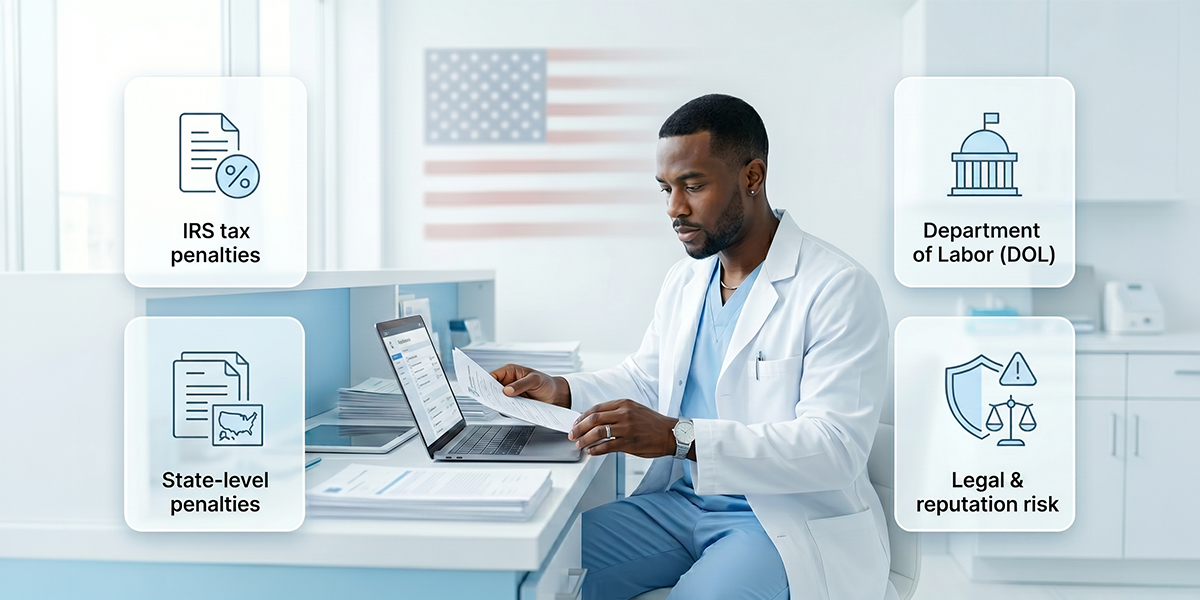
Misclassifying dental staff in the USA can lead to audits, penalties, back taxes, and operational disruptions.
- IRS Tax Penalties: If a worker is misclassified, the IRS can require dental practices to pay back payroll taxes, including the employer and employee portions of Social Security and Medicare, along with income tax withholding liabilities, penalties, and interest.
- Department of Labor (DOL) Penalties: The U.S. Department of Labor (DOL) enforces wage and hour laws under the Fair Labor Standards Act. Misclassification can result in back pay for unpaid minimum wages and overtime, as well as civil penalties in cases of repeated violations.
- State-Level Penalties: Though penalties may vary based on the state, agencies impose financial burden on the practice, including unpaid state payroll taxes, unemployment insurance contributions, and workers’ compensation premiums.
- Legal & Reputation Risks: Misclassification not only results in legal issues but also damages the reputation of the dental practice. The claims by workers for unpaid Wages, benefits, and damages lead to such risks, making it harder for the practices to recruit and retain qualified staff.
W-2 vs 1099 in Dentistry: Which Is Safer for Your Practice?
For dental practices in the United States, the safer option is not about hiring W-2 dental professionals or 1099 contractors. It is about correct classification based on the IRS guidelines. However, hiring W-2 employees is comparatively a safer approach for the dental offices in America as it ensures greater control over schedules, clinical protocols, and patient care. 1099 contractors should be used selectively for independent, short-term, or specialised roles like locum tenens dentists, consultants, and advisors.
Dental Staffing Solution That Reduces Compliance Risk
Though W-2 dental staffing is generally a safer and more compliant option for dental practices, what often holds practices back is the increased administrative burden that comes with managing payroll taxes, benefits, compliance requirements, and ongoing HR responsibilities. For dental practices with such concerns, collaborating with a trusted dental staffing agency that provides W-2 dental staff without any 1099 dental employee legal risks is necessary.
Dental Dynamic Staffing (DDS) is a W-2 dental staffing solution used across the United States. DDS offers pre-vetted, qualified dental professionals for a wide range of roles. Whether it is direct hire, short-term contracts, same-day substitutes, or permanent staff, DDS connects dental practices with the right candidates. As this dental staffing agency handles all administrative tasks, including compliance, payroll, and taxes, dental practices can avoid time-consuming legal paperwork. This allows practices to focus more on patient care and operational efficiency.
Conclusion
Understanding W-2 vs 1099 employees is essential for dental practices in the United States to stay compliant and manage risk effectively. While both classifications offer distinct advantages, misclassification can expose practices to serious dental worker misclassification legal risks, including penalties, audits, and financial liabilities. Although W-2 dental staffing is generally the safer and more compliant option, many practices hesitate due to the administrative responsibilities involved, such as payroll, tax handling, and regulatory compliance. However, partnering with a reliable dental staffing agency like Dental Dynamic Staffing can help overcome these challenges. By managing compliance, payroll, and tax obligations, DDS enables practices to benefit from W-2 staffing without the added administrative burden, allowing them to prioritise patient care and streamlining daily operations.
Want to eliminate administrative burden on your practice and stay compliant?
Find qualified W-2 dental professionals with Dental Dynamic Staffing.
Related posts